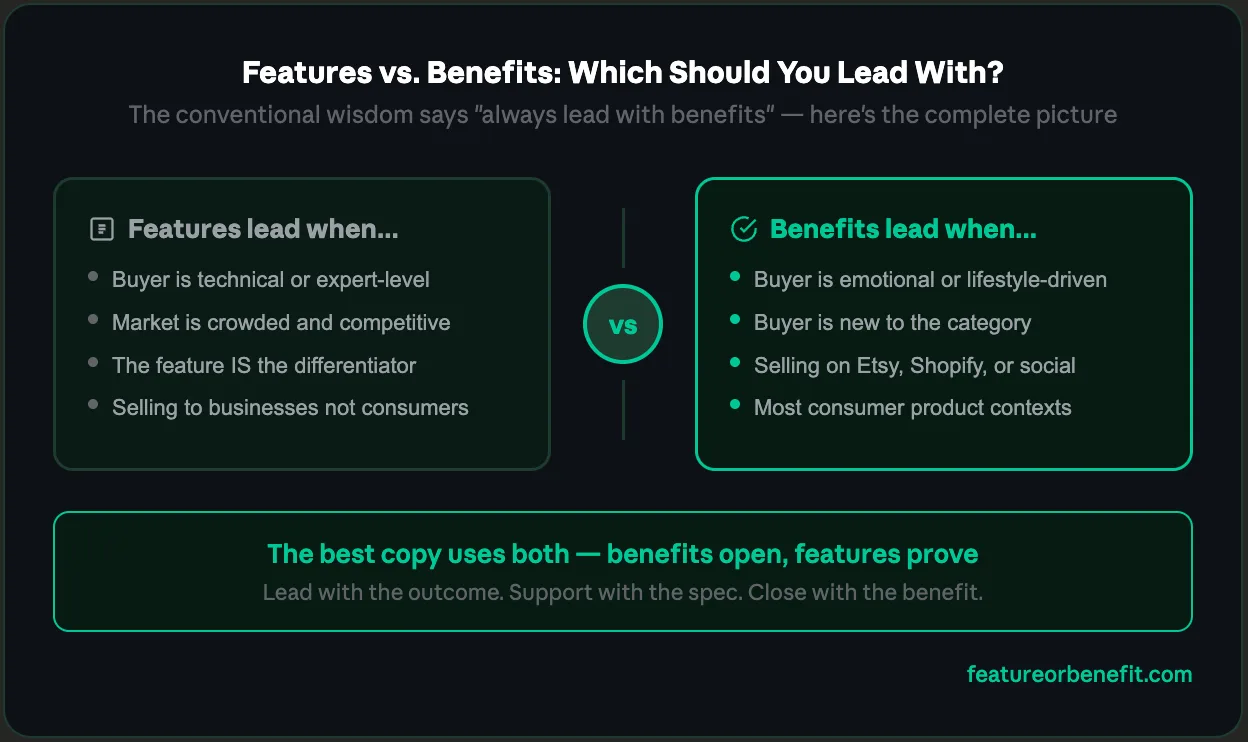
Every guide about marketing copy tells you the same thing: lead with benefits, not features. Benefits sell. Features just describe. Always start with the customer outcome.
It's good advice, most of the time. But like most absolute rules in marketing, it has exceptions that matter. And understanding those exceptions is what separates copy that converts across every context from copy that works in some situations and falls flat in others.
Here's the complete picture: when to lead with benefits, when features deserve the spotlight, and how to combine both for maximum effect.
Why Benefits Are Usually the Right Call
The case for leading with benefits is strong and well-founded. Most buyers — whether they're shopping on Etsy, browsing your Shopify store, or reading a brand service page — are primarily motivated by self-interest. They want to know what's in it for them. They're not thinking about your product; they're thinking about solving their problem, their occasion, or their desired outcome.
When you lead with a benefit, you immediately speak to what the buyer already cares about. You're answering the question they're silently asking before they've had to ask it. That's why benefit-led copy consistently outperforms feature-led copy in most consumer contexts.
Consider these two openings for the same product:
Feature-led: "Made with 18/8 stainless steel and a vacuum-sealed double-wall construction."
Benefit-led: "Keep your coffee hot for 12 hours and your water cold all day — no more lukewarm drinks by mid-morning."
Most buyers respond more immediately to the second version because it speaks directly to an experience they've had and want to fix. The feature in the first version is real and relevant — it also requires the reader to do mental work to connect it to their life. Benefit-led copy does that work for them.
For most small business product listings, social media posts, and website copy, leading with benefits is the right default.
When Features Should Lead
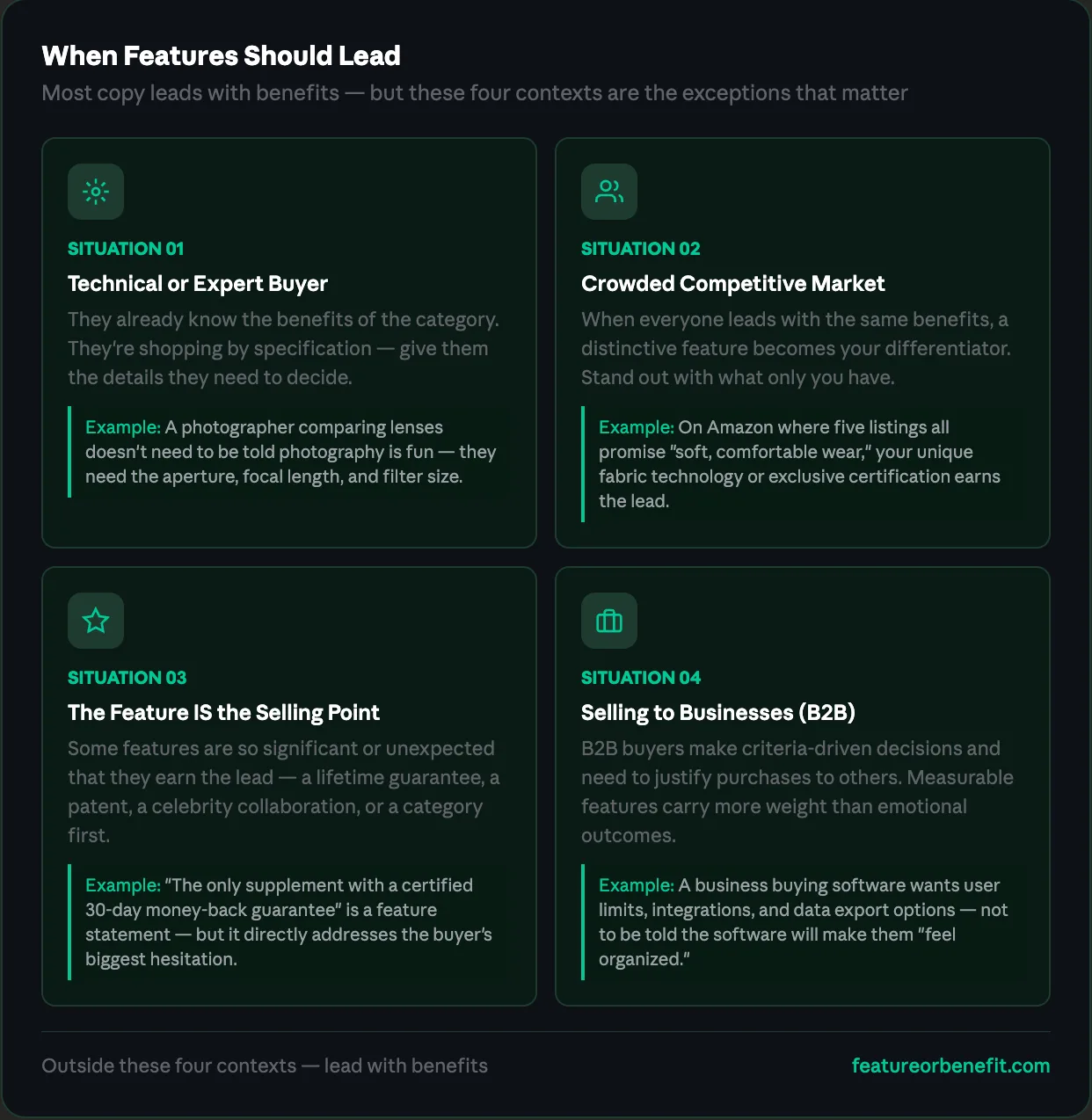
Here's where the nuance comes in. There are specific situations where features deserve top billing — and getting this wrong can actually hurt your conversion rate.
When Your Buyer Is Technical or Expert-Level
Some buyers know exactly what they need and are shopping by specification. A photographer comparing camera lenses, a baker evaluating stand mixer capacity, a software developer assessing an API — these are feature-first decision-makers. They already know the benefits of their category. What they need is the technical detail that tells them whether your specific product meets their requirements.
Leading with benefits in these contexts can feel condescending or vague. "Capture professional-quality images" means nothing to a photographer who's already a professional. "72mm filter thread, 9 aperture blades, 1:1 macro ratio" tells them exactly what they need to know.
Know your buyer. If they're shopping by spec, give them specs upfront.
When You're in a Crowded, Competitive Market
In highly saturated categories where multiple products deliver similar benefits, features become your differentiator. If everyone on the page is promising "soft, comfortable, all-day wear," focus on the feature that sets your product apart — the specific fabric, the unique construction, the exclusive technology. This becomes the story worth leading with.
This is particularly relevant on Amazon, where buyers can compare five similar products side by side. In that context, your distinctive features are your competitive advantage and deserve to be prominent.
When the Feature IS the Selling Point
Sometimes a specific feature is so significant, so unexpected, or so directly relevant to the buyer's decision that it earns the lead. A lifetime guarantee. A celebrity collaboration. A patented ingredient. Being the only product in its category to do something. These are compelling differentiators that are expressed as features but function as benefits.
"The only collagen supplement with a certified 30-day money-back guarantee" is technically a feature statement — but it's also a powerful lead because the guarantee directly addresses the buyer's biggest hesitation: will this product work?
When You're Marketing to Businesses, Not Consumers
B2B buyers tend to make more analytical, criteria-driven decisions than consumer buyers. They're often accountable to someone else for their purchase decision and need to be able to justify it with specifics. In business contexts, features — particularly measurable ones — carry more weight than they do in consumer marketing.
A business buying a project management tool wants to know how many users it supports, what integrations are available, and whether the data is exportable. A consumer buying a journal wants to know how it will make them feel. Lead with what your specific buyer prioritizes.
The Most Effective Approach: Benefits Lead, Features Prove
For most small business copy — product listings, website pages, social media, email — the highest-converting structure isn't purely benefit-led or purely feature-led. It's a combination that uses both in the right sequence:
Benefits open the conversation. Features close the sale.
Your opening line hooks the reader with the outcome they care about. It answers "what's in it for me?" before they've had to ask. This is where you earn their attention and give them a reason to keep reading.
Your body copy then supports that benefit promise with the features that make it credible. Features serve as evidence — they answer the follow-up question: "How do I know this product will actually deliver that outcome?"
Your closing confirms both: here's what you'll experience (benefit) because of what this product contains or does (feature).
A real example of this structure:
"Stay comfortable on the trail all day, whatever the weather. [Benefit — opens the conversation]
Our merino wool base layer regulates your body temperature naturally — warm enough when you're resting, breathable enough when you're climbing. [Benefit expanded]
18.5-micron 200gsm merino, odor-resistant, machine washable. [Features — prove the promise]
The only layer you need from trailhead to summit." [Benefit — closes the sale]
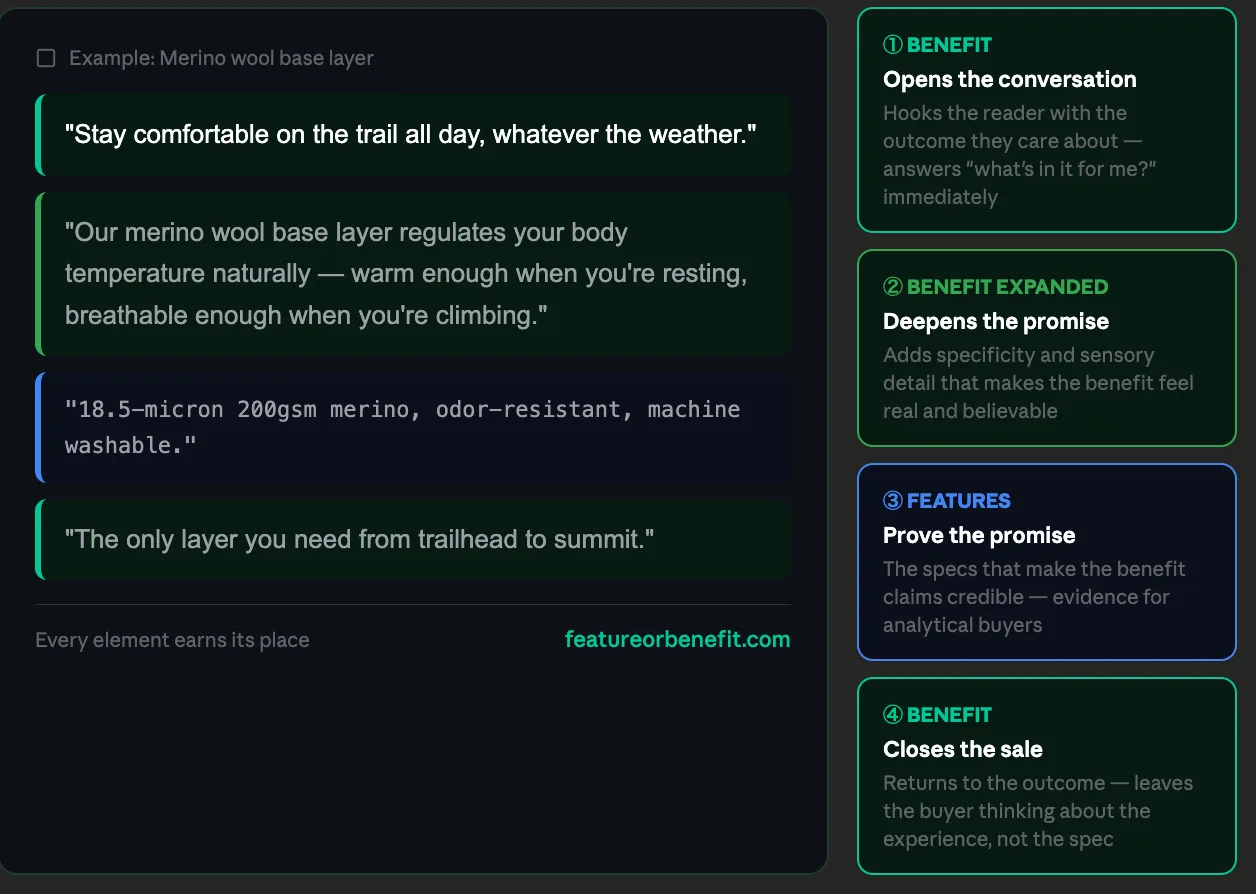
Every element earns its place. The features aren't leading, but they're not missing either — they're doing the essential job of making the benefit claims believable.
A Quick Decision Framework
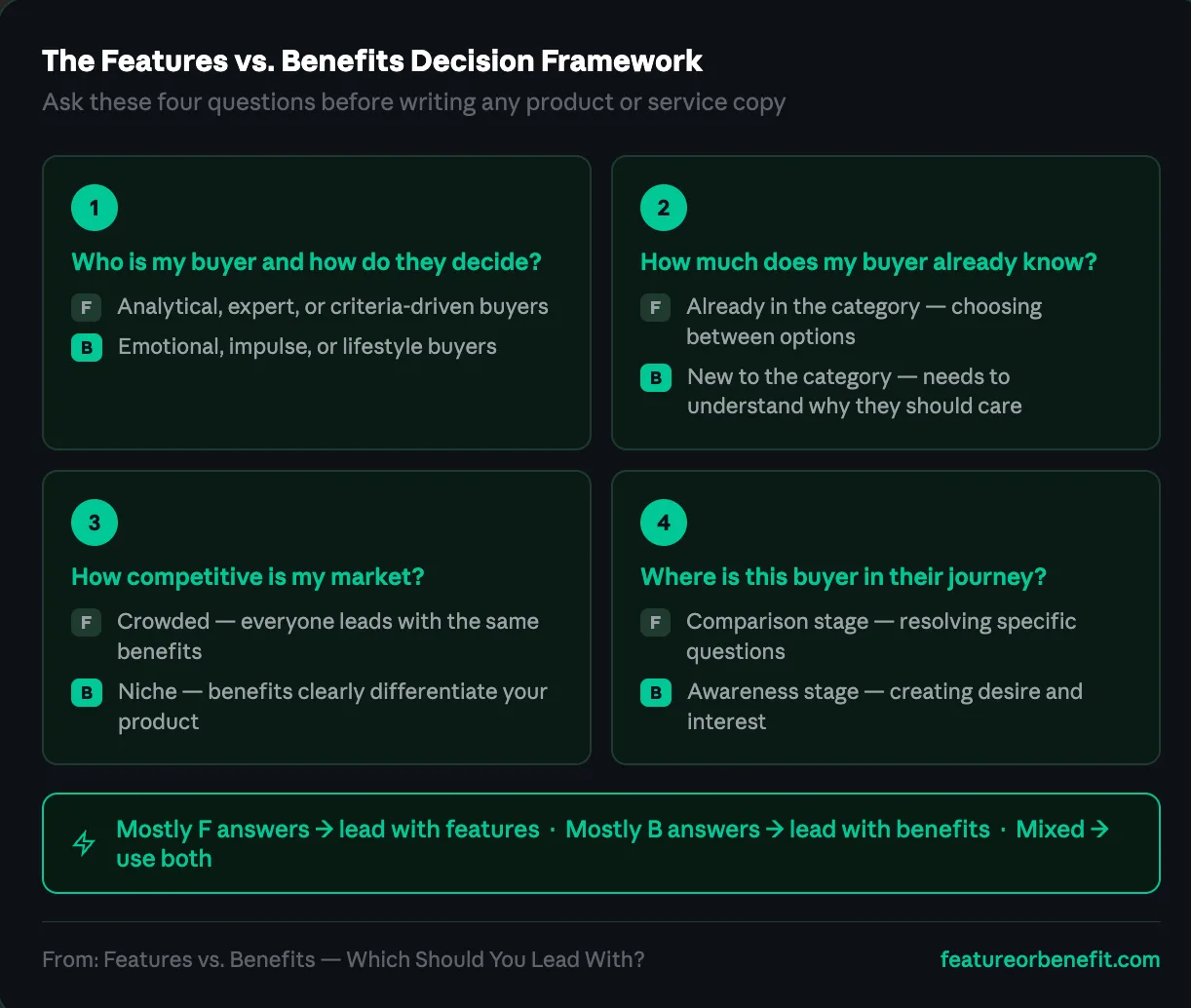
When you sit down to write a piece of marketing copy and aren't sure which to lead with, ask yourself these four questions:
1. Who is my buyer and how do they make decisions? Emotional, impulse, or lifestyle buyers respond to benefits. Analytical, expert, or criteria-driven buyers often want features first.
2. How much does my buyer already know? Buyers new to a category need benefits to understand why they should care. Buyers already in a category often need features to choose between options they're already considering.
3. How competitive is my market? In undifferentiated categories, benefits stand out. In highly competitive categories where everyone leads with benefits, a distinctive feature can be the differentiator.
4. Where is this buyer in their purchase journey? Early in the journey (awareness stage), benefits create desire. Later in the journey (comparison stage), features address specific questions and objections.
The Mistake to Avoid: Features Without Benefits
There's one approach that almost never works: leading with features and stopping there. Features without benefits leave the buyer to do all the interpretive work — to figure out on their own why the specification you just mentioned should matter to them.
Most buyers won't do that work. They'll move on.
If you include features in your copy — and you should — always connect them to an outcome. "18-hour battery life" is a feature. "Work through a full day without hunting for an outlet" is the benefit. Ideally, they appear together: "18-hour battery life — work through a full day without hunting for an outlet."
This pairing structure is the safest, most versatile approach across virtually any marketing context. It serves the analytical buyer who wants the spec and the emotional buyer who wants the outcome, in a single line of copy.
Putting It Into Practice
The next time you're writing product or service copy, try this quick exercise before you start:
Write down your three most important features. Then, for each one, write the benefit it delivers. Now look at both lists and ask: which one would make my ideal customer say "that's exactly what I need"?
The answer tells you which to lead with. In most cases, it will be a benefit. In some cases — technical products, crowded markets, B2B contexts — it will be the feature. In all cases, you'll want both present in your copy, in the right order for your specific buyer.
Struggling to find the benefit inside a feature? The Feature & Benefit Analyzer at featureorbenefit.com does the translation for you — enter your product features and get three compelling benefit statements instantly, ready to use in any marketing context.