Most Etsy SEO advice focuses on one thing: getting found. Keywords in your title, all 13 tags filled, the right categories selected. That's step one, and it matters.
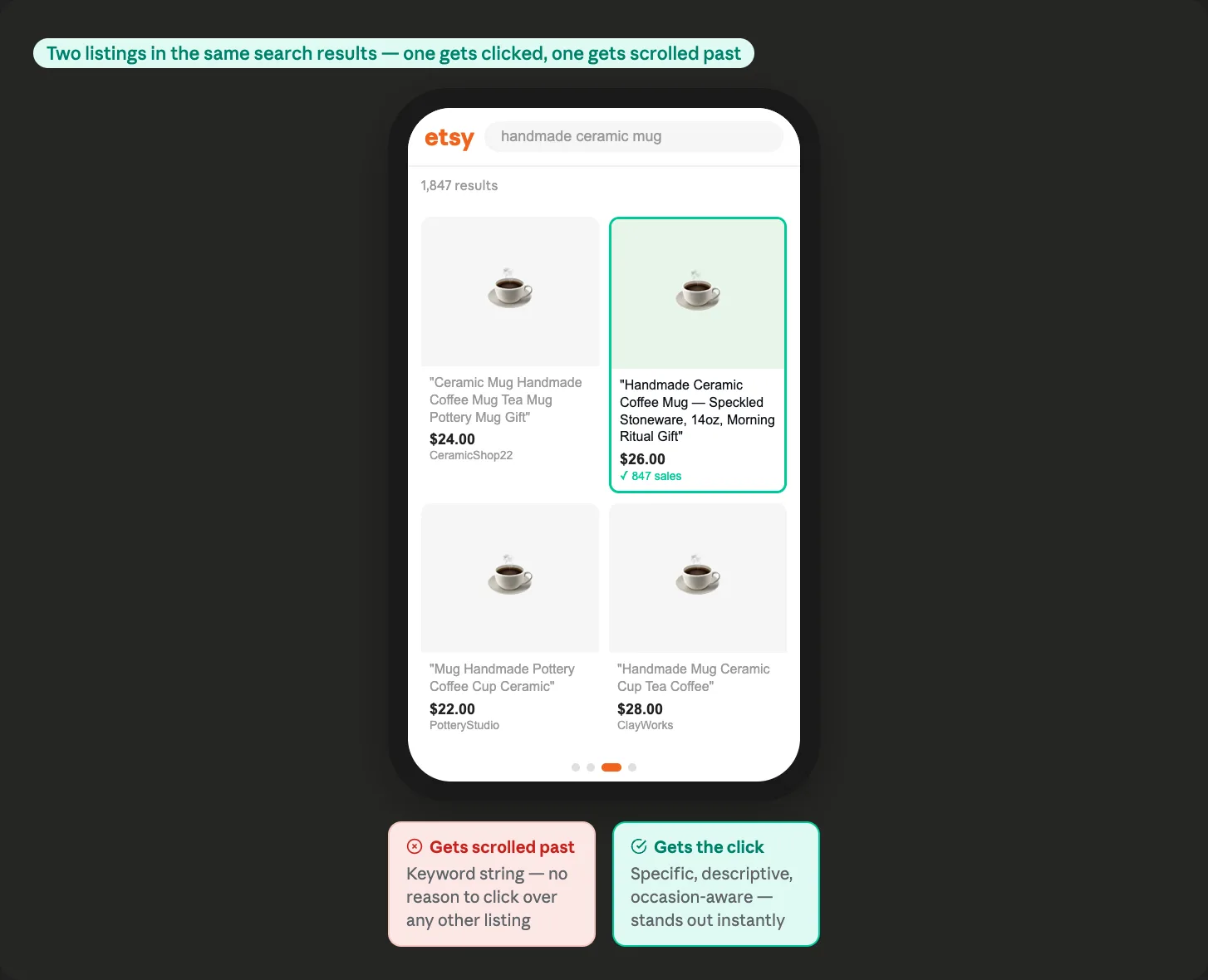
But here's what most Etsy guides don't tell you: getting found and getting clicked are two different problems. You can rank on page one for a relevant search and still watch shoppers scroll right past your listing because the title doesn't grab them, the thumbnail doesn't stop them, or the description doesn't give them a reason to care.
In 2026, Etsy's algorithm has made this even more consequential. Clicks, favorites, and purchases are performance signals the algorithm uses to decide how widely to show your listing. A listing that gets found but doesn't earn clicks is actively penalized. It gets shown to fewer and fewer shoppers over time.
This guide covers both sides of the equation: how to structure your listings to get found, and how to write them to get clicked and bought.
Why Etsy Shoppers Click — and Why They Don't
Understanding what motivates a click on Etsy starts with understanding how Etsy shoppers browse. The majority of Etsy shopping happens on mobile, in a fast-scrolling feed of thumbnail images. A shopper sees your listing for less than two seconds before deciding whether to tap or scroll on.
In that two-second window, three things are visible: your thumbnail image, your title, and your price. That's your entire first impression.
Your thumbnail is beyond the scope of this article, but your title is pure copy, and it's the most important copywriting decision you'll make for each listing. A title that speaks directly to what a shopper is looking for earns the tap. A title that's stuffed with keywords or too generic to be memorable doesn't.
Writing Titles That Get Clicked, Not Just Found
Etsy titles have two jobs: matching search queries so the algorithm shows your listing, and compelling shoppers to click when they see it. Most sellers optimize for the first job and ignore the second.
The key to doing both is front-loading your title with the most specific, buyer-intent phrase. These are the words a shopper would actually type when they're ready to buy. You then add descriptive details that make your listing feel relevant and appealing.
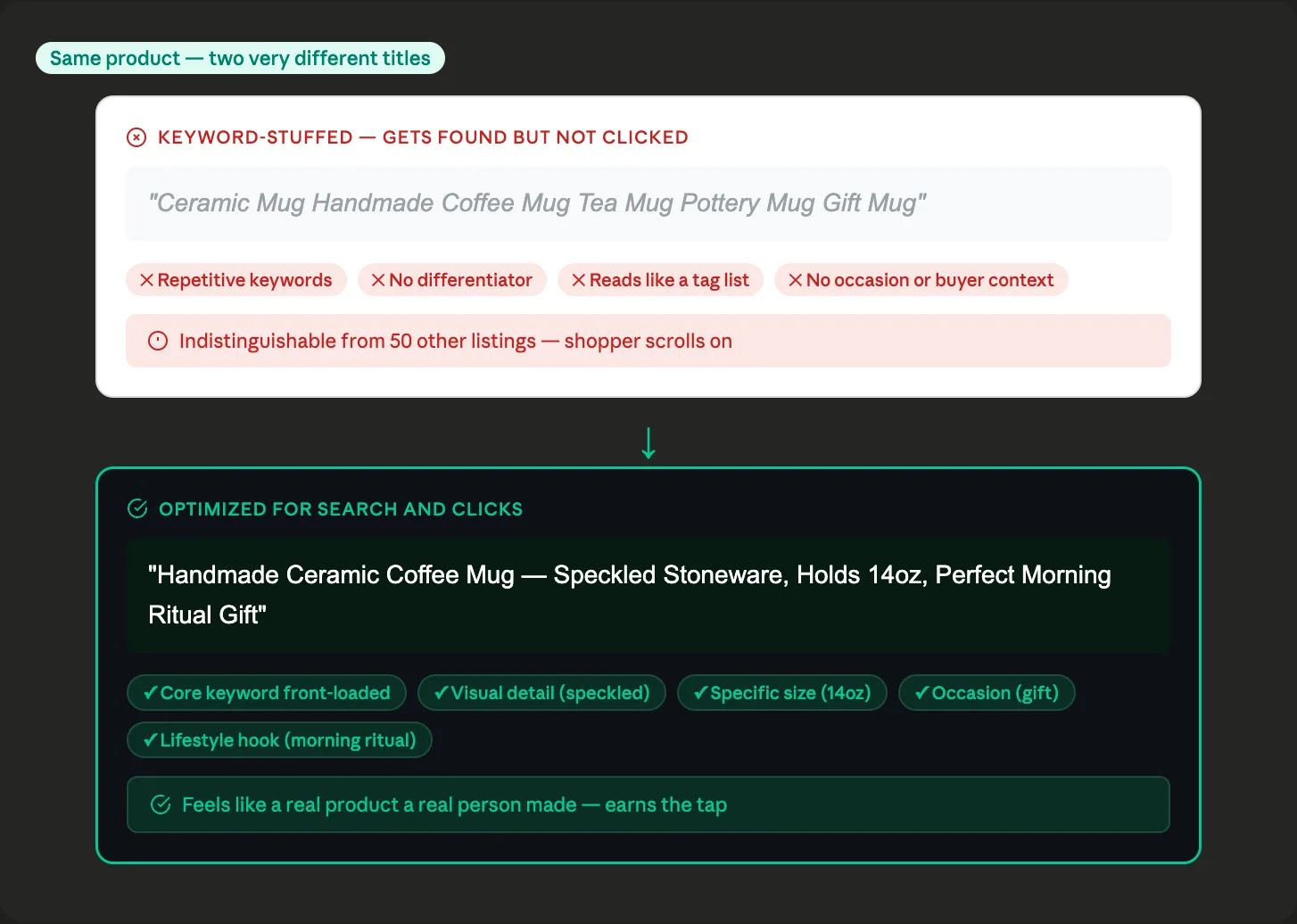
Here's the difference in practice for a handmade ceramic mug:
Keyword-stuffed but not compelling: "Ceramic Mug Handmade Coffee Mug Tea Mug Pottery Mug Gift Mug"
Optimized for both search and clicks: "Handmade Ceramic Coffee Mug — Speckled Stoneware, Holds 14oz, Perfect Morning Ritual Gift"
The second title targets the same core search terms but adds specificity, such as the speckled finish, size, and occasion. This makes it feel like a real product, a real person-made one, rather than a keyword list wearing a title's clothes.
A few title principles that consistently improve click-through rates on Etsy:
Be specific about what makes yours different. "Handmade candle" is generic. "Hand-poured soy candle — slow 80-hour burn, no synthetic fragrance" tells the shopper exactly what sets yours apart in the first glance.
Include the occasion when relevant. Gift occasion searches like birthday, wedding, anniversary, and Mother's Day drive enormous Etsy traffic. If your product works as a gift, say so in the title.
Use natural language, not keyword strings. Etsy's AI-powered algorithm is increasingly adept at understanding conversational phrasing, so titles that read naturally perform better than titles that rely on awkward keyword repetition. Write your title the way a person would describe the product to a friend, not the way you'd fill a metadata field.
The Product Description: Where Etsy Browsers Become Buyers
Once a shopper clicks your listing, your description takes over. This is where the sale is made or lost, and it's where most Etsy sellers leave the most money on the table.
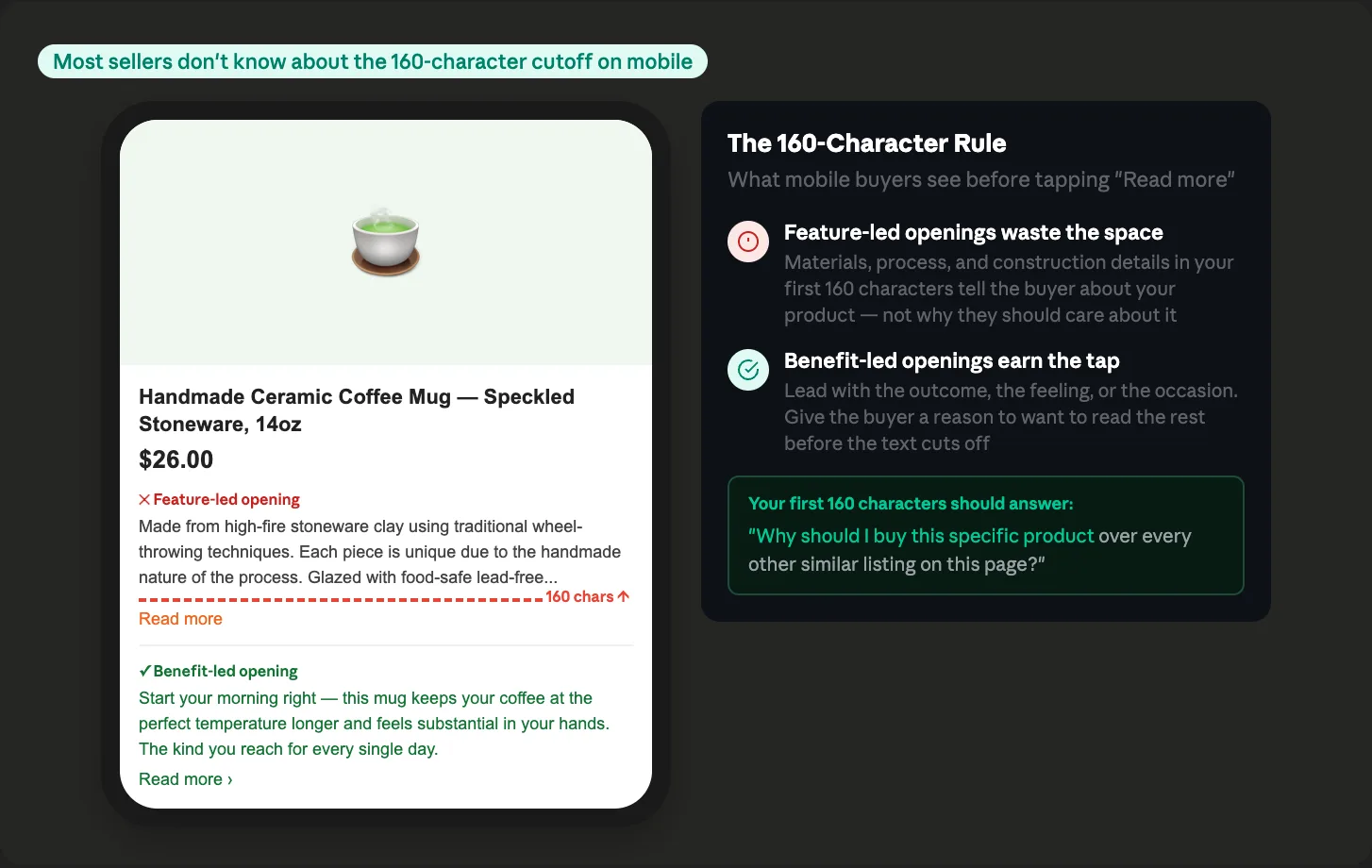
The most important thing to know about Etsy descriptions is that the first 160 characters are critical. That's what shoppers see before they have to tap "read more." Everything after that is valuable but conditional on earning that first tap.
Your first 160 characters should lead with your strongest benefit. This is the most compelling reason this product will improve the buyer's life, solve their problem, or make their occasion memorable. Not the materials. Not the dimensions. Not your shop name. The outcome the buyer is shopping for.
After that opening hook, your description should move through a clear sequence:
Expand on the benefit with sensory detail and specificity. What does it feel like? What problem does it solve? What moment does it belong in? This is where emotional connection is built.
Translate your features into benefits. Every spec in your listing, including the materials, the size, and the process, should be paired with the outcome it delivers for the buyer. "Made from 100% soy wax" is a feature. "Burns clean without the black soot that stains walls and ceilings" is the benefit that makes it matter.
Address the gift buyer. A significant portion of Etsy traffic comes from gift shoppers. If your product works as a gift, and most handmade products do, add a sentence specifically for them: "Makes a beautiful gift! Arrives carefully packaged and ready to give."
Cover the practical details. Size, materials, care instructions, customization options, and processing time. These belong in the description, but after the emotional copy, not before it.
The Tags and Attributes: Maximizing Your Search Footprint
While tags don't directly influence copy, they determine whether your listing shows up to be clicked in the first place, so they're worth covering briefly.
Use all 13 tags for every listing. Each tag is a separate opportunity to match a different search query, and leaving tags empty is leaving visibility on the table. Think about all the different ways a buyer might search for your product: by material, by occasion, by recipient, by style, by color, by use case.
Avoid repeating the same keywords across your title and tags because Etsy's algorithm already connects these, so repetition wastes tag slots you could use to capture additional search queries.
Fill out every relevant attribute in your listing. Attributes serve as primary signals for query matching and help listings appear in filtered sidebar searches. Shoppers filtering by color, size, or material will only see listings with those attributes correctly filled out.
Photos: The Click Before the Click
Your thumbnail photo is the click decision, before the shopper even reads your title. While photo composition is outside the scope of this article, one copy principle applies directly to your photo strategy: your hero image should show the benefit, not just the product.
A candle photographed on a white background against a wall only shows the product. A candle photographed on a cozy side table, next to a book and a cup of tea, on a rainy afternoon, illustrates the benefit. Shoppers see the atmosphere, the feeling, the moment it belongs in. Lifestyle photography that puts your product in context consistently outperforms product-only photography for click-through rates on Etsy.
Putting It All Together: A Listing Audit Checklist
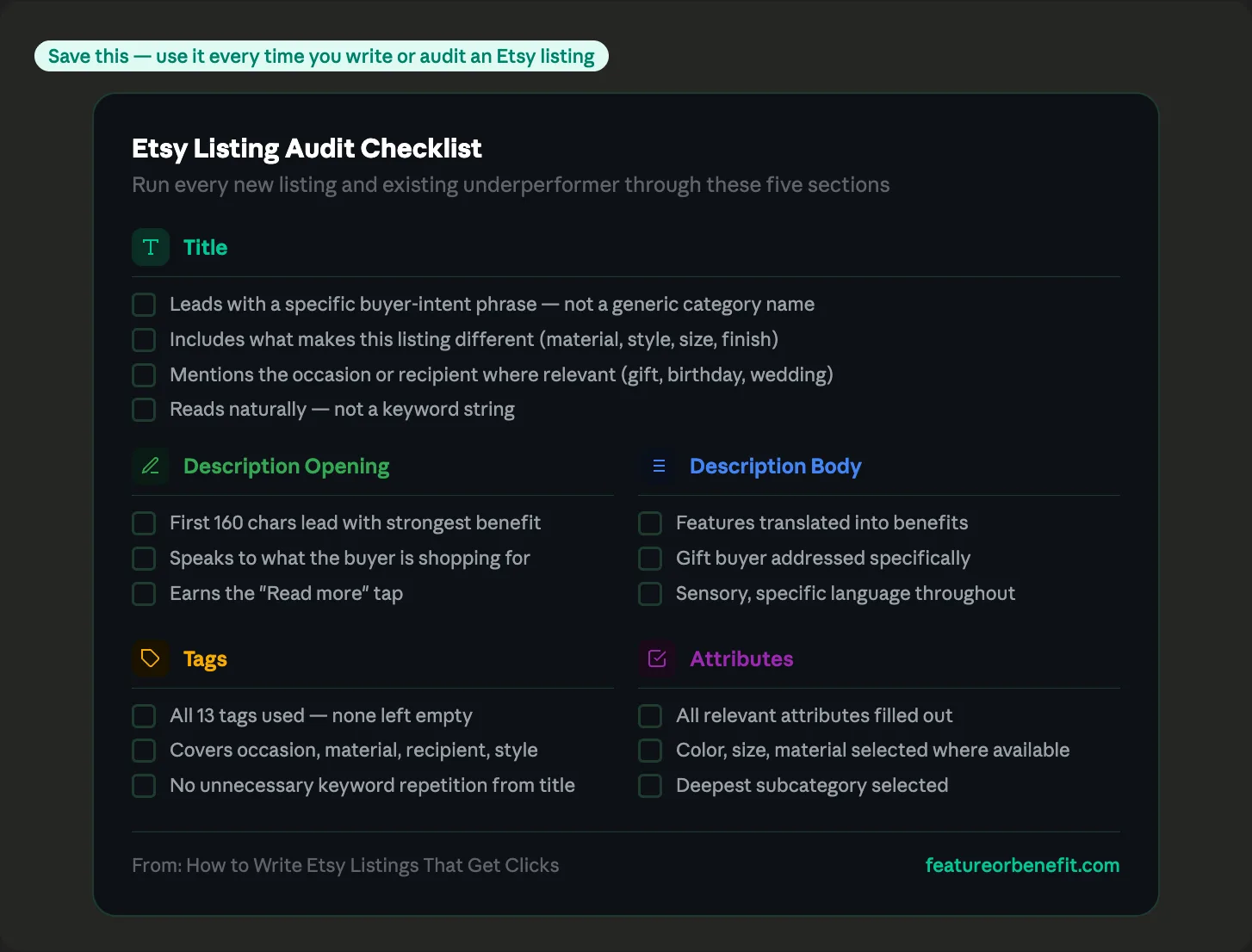
Use this checklist when writing new listings or auditing existing ones:
Title:
- Leads with a specific, buyer-intent phrase
- Includes what makes this listing different
- Mentions the occasion or recipient where relevant
- Reads naturally and is not a keyword string
Description opening (first 160 characters):
- Leads with the strongest benefit, not materials or dimensions
- Speaks directly to what the buyer is shopping for
- Earns the "read more" tap
Description body:
- Features translated into benefits throughout
- Gift buyer addressed specifically
- Sensory and specific language with no vague superlatives
- Practical details covered after the emotional copy
Tags:
- All 13 tags used
- Covers multiple search angles like occasion, material, recipient, and style
- No unnecessary keyword repetition in the title
Attributes:
- All relevant attributes filled out completely
The Copy That Connects Everything
The single most important shift you can make to your Etsy listings is also the simplest: stop writing about your product and start writing about your buyer's experience of your product.
Every title decision, every description line, every tag should answer the same question: Does this speak to what my ideal buyer is looking for? When the answer is consistently yes, your listings earn clicks, your clicks earn sales, and your sales earn the algorithm's attention.
Need help translating your product features into the benefit language that converts Etsy browsers into buyers? The Feature & Benefit Analyzer at featureorbenefit.com generates three compelling benefit statements from your product features instantly — ready to use in your titles, descriptions, and marketing copy.