Writing product descriptions that actually sell is one of the highest-leverage skills a small business owner can develop. A description on your product page that converts turns your existing traffic into revenue without spending an extra dollar on advertising. A description that doesn't convert wastes every click you've already paid for. You lose time, money, or both.
The good news is that writing compelling product descriptions doesn't require a copywriting degree or years of marketing experience. It requires understanding a few core principles and applying them consistently. This guide walks you through the process step by step.
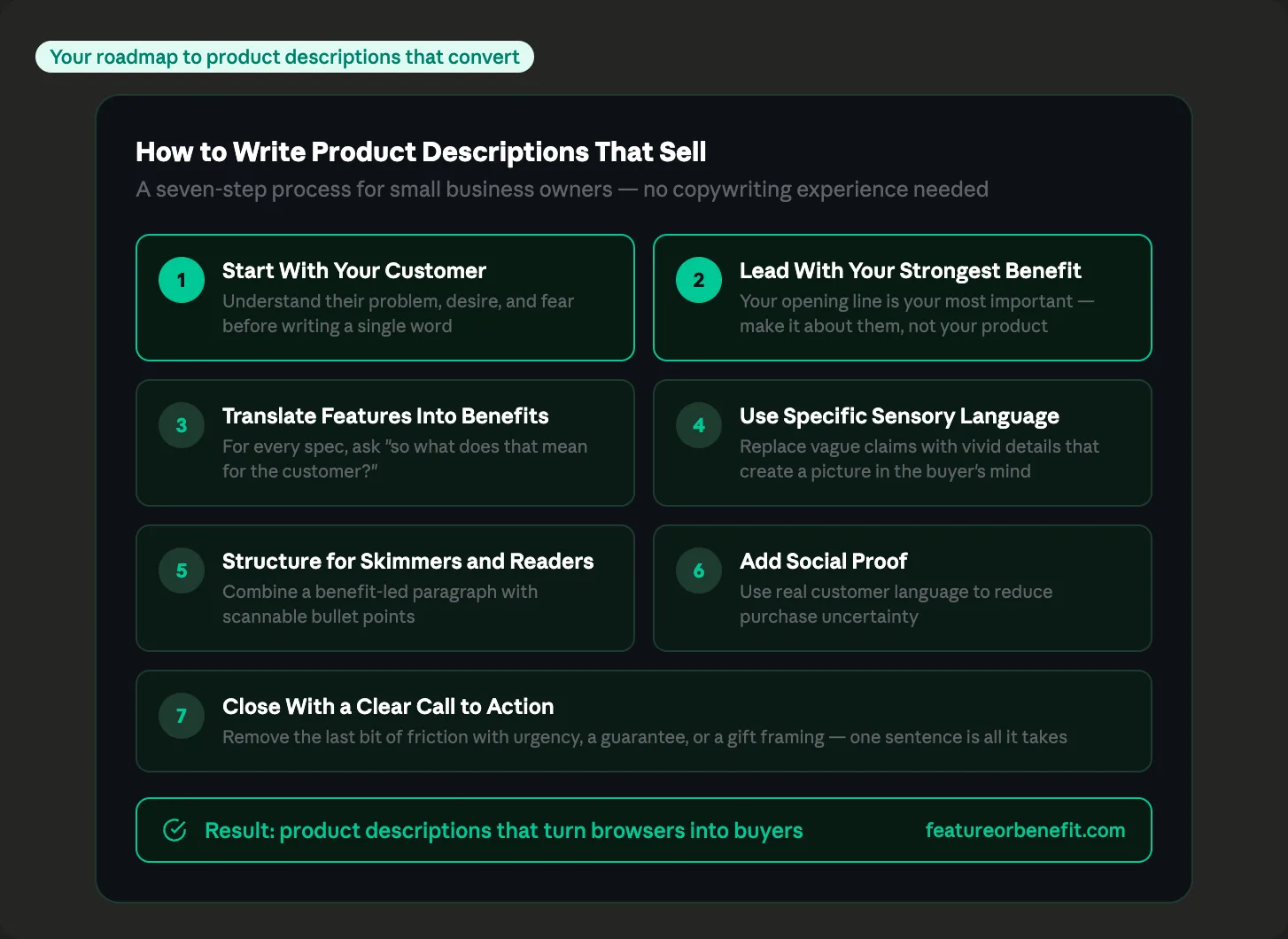
Step 1: Start With Your Customer, Not Your Product
The most common mistake small business owners make when writing product descriptions is starting with the product. They open their laptop, look at what they're selling, and describe it — sometimes in detail. The product copy includes the materials, dimensions, process, and features. It's a natural instinct, especially when you're proud of what you've made or sourced.
But your customer isn't thinking about your product. They're thinking about themselves. Their problem, their occasion, their desire, their life. A description that starts from the customer's perspective converts at a significantly higher rate than one that starts from the product.
Before writing a single word, ask yourself these questions about your ideal buyer:
- What problem are they trying to solve, or what feeling are they chasing?
- What are they afraid of getting wrong with this purchase?
- What would they tell a friend about this product if they loved it?
- Are they shopping for themselves or for someone else?
The answers to these questions should shape every word of a good product description. You're not describing a product — you're describing the solution to a problem your customer already has.
Step 2: Lead With Your Strongest Benefit
Your opening sentence is the most important sentence in your product description. This is critical for mobile. The majority of marketplace browsing happens here, and it may be the only sentence a potential buyer reads before deciding whether to scroll or leave.
Most descriptions open with the product name or a feature. The most converting descriptions open with the customer's strongest benefit. This is the single most compelling reason this product will improve their life.
Compare these two openings for the same product:
Feature-led opening: "Hand-poured in small batches using 100% soy wax and a cotton wick, available in 8oz and 12oz sizes."
Benefit-led opening: "Fill your home with fragrance for weeks without the chemical smell or sooty residue that comes from most candles."
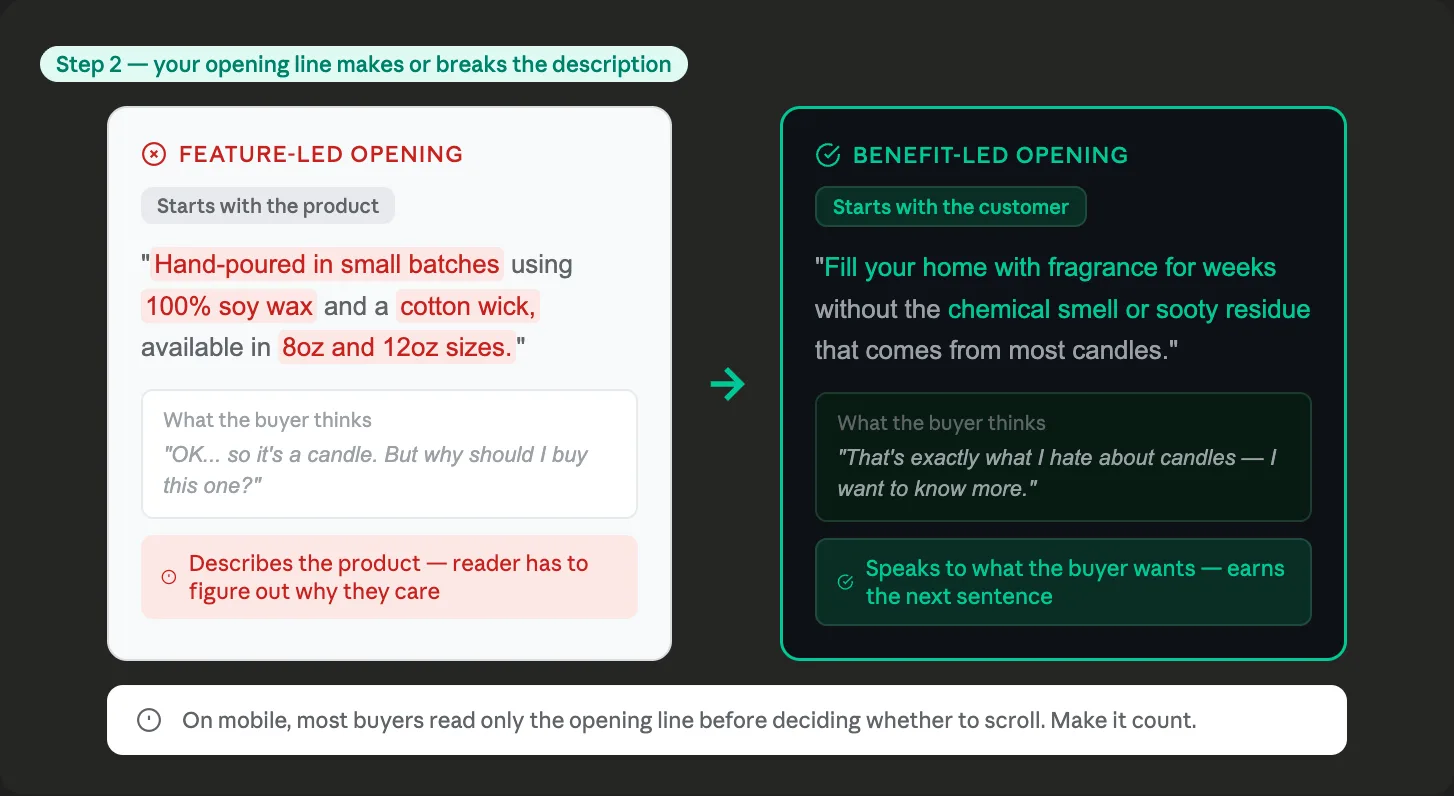
The second opening speaks directly to what the buyer wants (fragrance, cleanliness) and what they want to avoid (chemicals, soot). It earns the next sentence in a way the first version doesn't.
Identify the single most compelling benefit your product delivers. This is the one that most directly addresses the desire or fear of your target audience. Make it your opening line. If you're looking for other examples, we've got them here!
Step 3: Translate Every Feature Into a Benefit
Once you've hooked the reader with your opening, the body of your description should support that promise with evidence. This is where features become valuable — to prove that your benefit claims are real.
The translation process is straightforward once you know the pattern. For every feature in your product, ask: "So what does that mean for the customer?" The answer is your benefit.
Here's how that looks in practice across different product types:
Home goods: Feature: "Stainless steel with a non-scratch silicone base." Benefit: "Protects your counters and surfaces while you work, preventing slipping and marks."
Apparel: Feature: "Four-way stretch fabric." Benefit: "Move all day freely — whether you're at a desk, running errands, or heading out — no pulling, no restricting."
Service business: Feature: "Same-day response guarantee." Benefit: "Your time is valuable. Don't wait a week — you'll have an answer and a plan by the end of the day."
Digital product: Feature: "Instant download after purchase." Benefit: "Get started in the next five minutes. No waiting, no shipping, no delay."
Work through every feature in your product this way. Not every translation will make it into your final description. Choose the three to five most compelling benefits and build around those.
Step 4: Use Specific, Sensory Language
Vague claims are invisible to buyers. Words like "high quality," "premium," "beautiful," and "luxurious" appear so often in product descriptions that readers have learned to skip past them entirely. They add length without adding conviction.
Specific, sensory language does the opposite. It creates a picture in the buyer's mind that makes the product feel real and tangible even though they can't touch it.
Compare these two descriptions of the same blanket:
Vague: "Made from premium materials, this luxurious blanket is soft and comfortable."
Specific and sensory: "Wrap yourself in something that feels like a warm hug — the kind of blanket you reach for the moment you sit down on the couch."
The second version creates an experience. The buyer can almost feel it. That's the standard to aim for.
Replace every vague adjective with either a specific detail or a sensory description of the experience. "Soft" becomes "softer than anything you've worn to bed." "Durable" becomes "built to outlast three moves and still look new." "Effective" becomes "works in the first use or your money back."
Step 5: Structure for Skimmers and Readers
Different buyers consume product descriptions differently. Some read every word. Most skim. Effective product descriptions need to work for both.
The most effective structure combines two elements:
An opening paragraph (2–4 sentences) that leads with your strongest benefit, creates an emotional connection, and earns the reader's continued attention. This is your hook. Write it as if it's the only thing the buyer will read, because for many of them, it is.
A short bulleted list (4–6 bullets) that covers your key features and supporting benefits in a scannable format. Bullets give skimmers a way to quickly extract essential information. For SEO, they give search engines clear signals about what your product contains.
The winning combination looks like this:
[Opening paragraph — lead with benefit, create emotional connection]
Then:
- Key feature translated into a benefit
- Second feature translated into a benefit
- Third feature translated into a benefit
- Practical detail (size, material, compatibility)
- Delivery or fulfillment promise
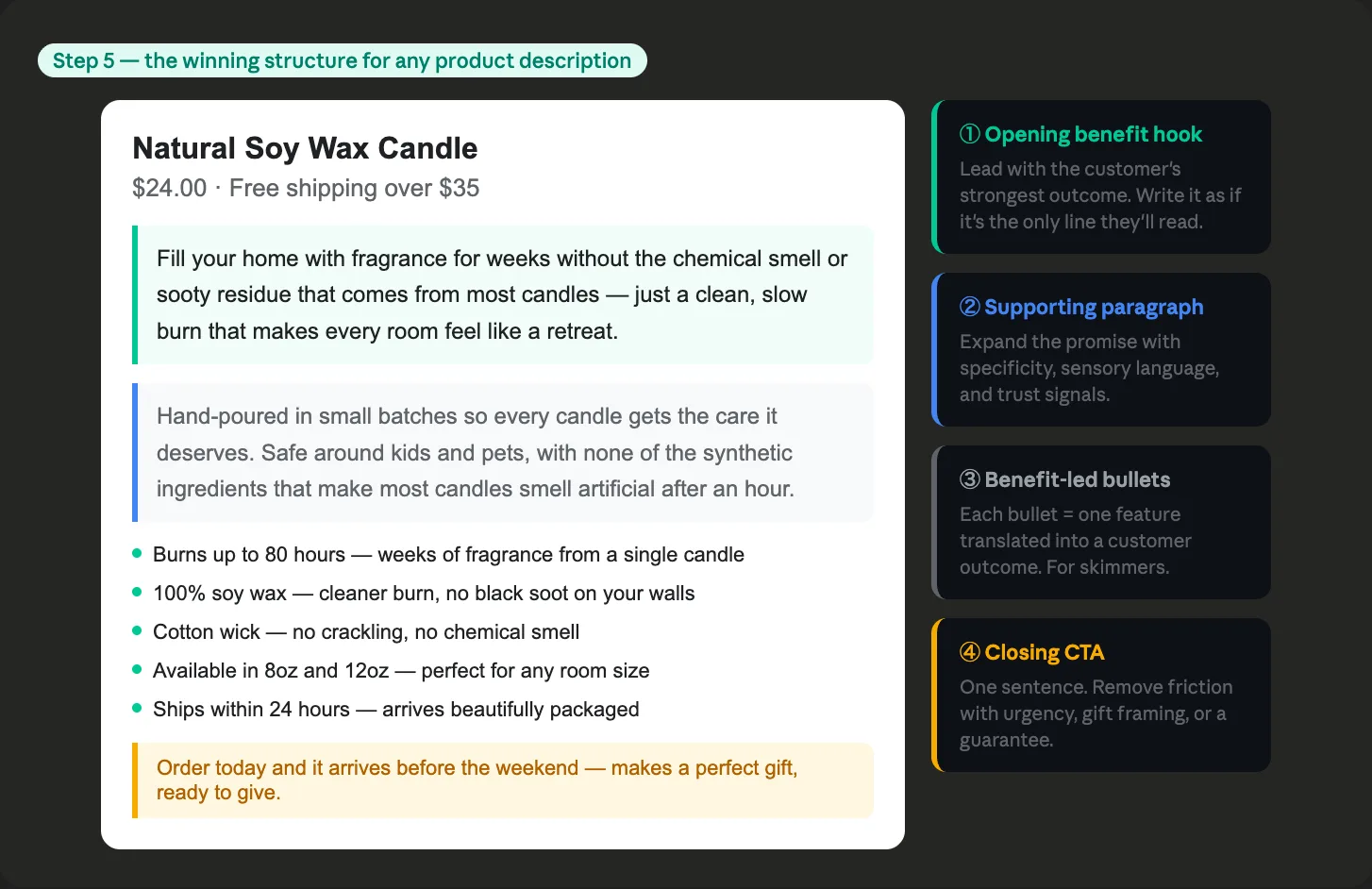
This structure works on Etsy, Shopify, Amazon, or your own website. It serves both the human reader and the search algorithm.
Step 6: Add Social Proof Where You Can
A buyer reading your product description is making a decision under uncertainty. They can't hold the product, try it on, or ask a friend who owns one. Anything you can do to reduce that uncertainty increases the chance they'll buy.
Social proof is one of the most powerful tools available. If you have positive reviews, pull the most specific and vivid phrases from them and work them into your description or feature them prominently near it. A real customer saying "I've bought three of these as gifts and everyone asks where I got it" does more persuasive work than anything you could write yourself.
If you're newer and don't have reviews yet, you can still build trust with specificity. Exact numbers ("ships within 24 hours," "loved by 400+ customers," "makes a great gift for anyone who...") signal confidence and credibility in the absence of review volume.
Step 7: Close With a Clear Call to Action
Many product descriptions end without a clear next step. Buyers who are almost convinced sometimes just need a gentle nudge to move from browsing to buying. A closing line that creates mild urgency or reinforces the value often provides it.
A few approaches that work well for small business products:
- Timeliness: "Order by Thursday and it arrives before the weekend."
- Scarcity: "Made in small batches — once this run sells out, the next one won't be ready for six weeks."
- Gift framing: "Makes a perfect gift and arrives beautifully packaged and ready to give."
- Guarantee: "Not happy with it? Contact us and we'll make it right — no questions asked."
Keep it one sentence. You've already done the selling. Here, you're just removing the last bit of friction between the buyer and the purchase.
Putting It All Together: A Simple Template
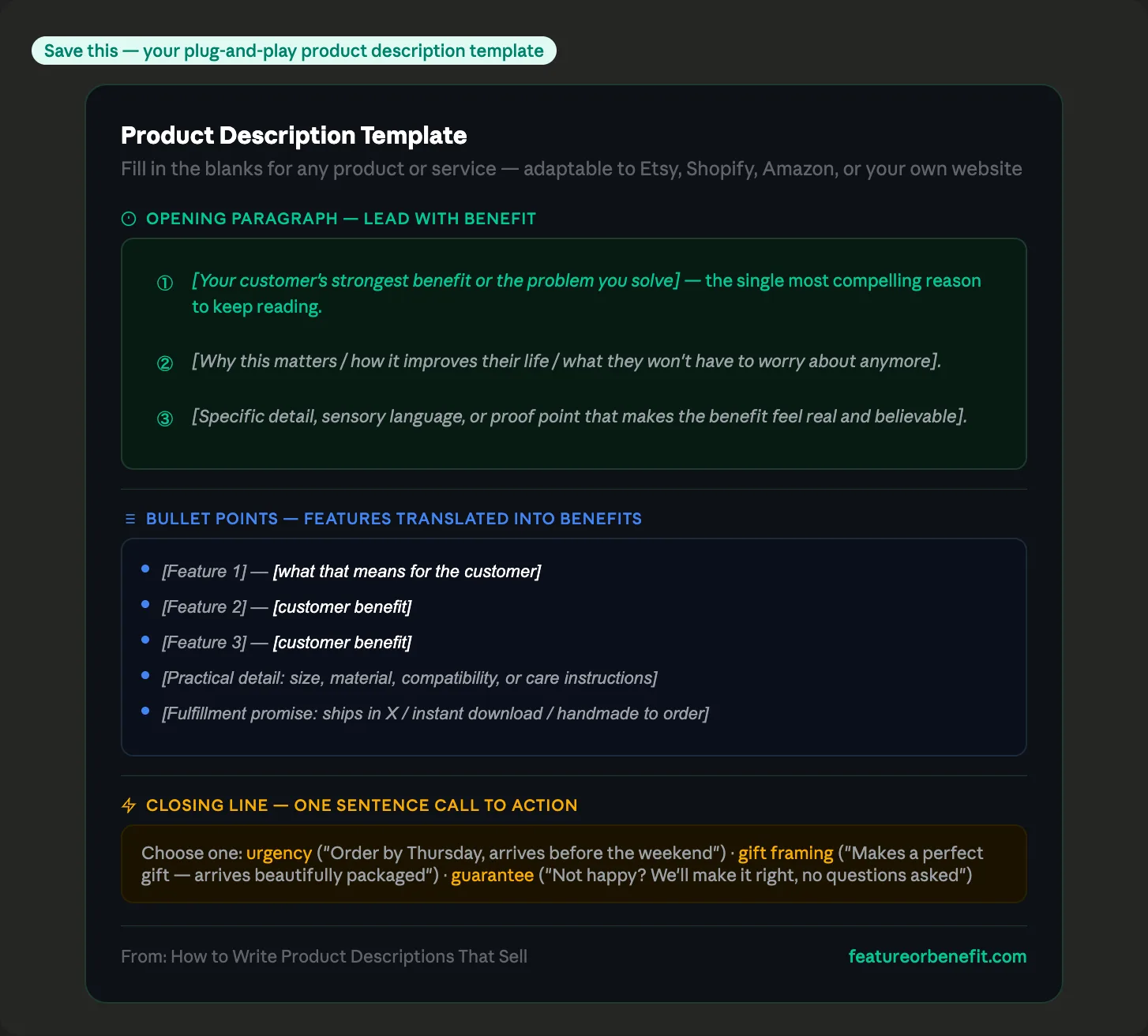
Here's the complete structure in template form, adaptable to any product:
Opening line: Lead with the customer's strongest benefit or the problem you solve.
Second sentence: Expand on why this matters or how it improves their life.
Third sentence: Add specificity — a sensory detail, a number, or a proof point.
- Key feature → customer benefit
- Key feature → customer benefit
- Key feature → customer benefit
- Practical detail (size, material, compatibility, care instructions)
- Fulfillment promise (ships in X, instant download, handmade to order)
Closing line: Gentle call to action. Use urgency, gift framing, or a guarantee.
The Fastest Way to Generate Benefit Language
The most time-consuming part of this process for most small business owners is Step 3 — translating features into benefits across an entire product catalog. It's the step that requires the most creative thinking, and it's the one that tends to get skipped when time is short.
The Feature & Benefit Analyzer at featureorbenefit.com does this step for you. Enter your product features, upload a product image, and the tool generates three compelling benefit statements instantly. Use them as your opening line, your bullet points, or your social media captions.
It's built specifically for small business owners who know their products inside out but want help translating that knowledge into copy that converts.
Try it free at featureorbenefit.com — no credit card required.