Most small business owners didn't start their business because they love writing. They started it because they're good at what they do, whether that's making things, fixing things, serving people, or solving problems. The writing came later, as an unavoidable necessity of running a business in a world where words are everywhere: your website copy, your product listings, your social media, your emails, your signage.
The good news is that effective marketing copy doesn't require a professional copywriter or a marketing degree. It requires understanding a handful of principles that, once learned, apply to everything you'll ever write for your business. This guide covers the essentials. Not marketing theory, but the practical skills that make the difference between copy that gets ignored and copy that gets results.
Start With One Person, Not Everyone
The most common mistake in small business marketing copy is writing for everyone. "Our products are for anyone who wants quality" sounds inclusive, but connects with no one. The broader your audience, the more generic your copy has to be. Unfortunately, generic copy doesn't convert.
The most effective marketing copy is written for one specific person: your ideal customer. Not a demographic ("women aged 25–45") but a real person with a specific problem, desire, fear, or occasion driving their search.
Before writing anything, answer these three questions about your ideal buyer:
What are they trying to accomplish or solve? Not "buy a candle". That's the transaction. What's the underlying motivation? Relaxation after a stressful week? Creating a welcoming atmosphere for guests? A meaningful gift for someone they care about?
What are they afraid of getting wrong? Every purchase involves risk. Quality that doesn't match the photos. A gift the recipient doesn't like. A service that doesn't deliver. Address those fears directly in your copy, and you remove the hesitation that stops browsers from becoming buyers.
What words do they use? Your ideal customer has specific language for their problem and their desired outcome. Use their words, not industry jargon or technical terms. This makes your copy feel as if it were written specifically for them.
Write those answers down. They're the brief for every piece of marketing copy you write.
Lead With the Outcome, Not the Offering
Here's the core principle that underlies every piece of effective marketing copy: your customers don't buy what you sell, they buy what it does for them.
A plumber doesn't sell pipe repairs. They sell the relief of a crisis solved, dry floors, and a house that works again. A graphic designer doesn't sell logos. They sell the confidence that comes with looking professional and the first impression that wins clients before a word is spoken. An Etsy seller doesn't sell handmade jewelry. They sell the feeling of wearing something unique that no one else has, or the joy of giving a gift that clearly took thought.
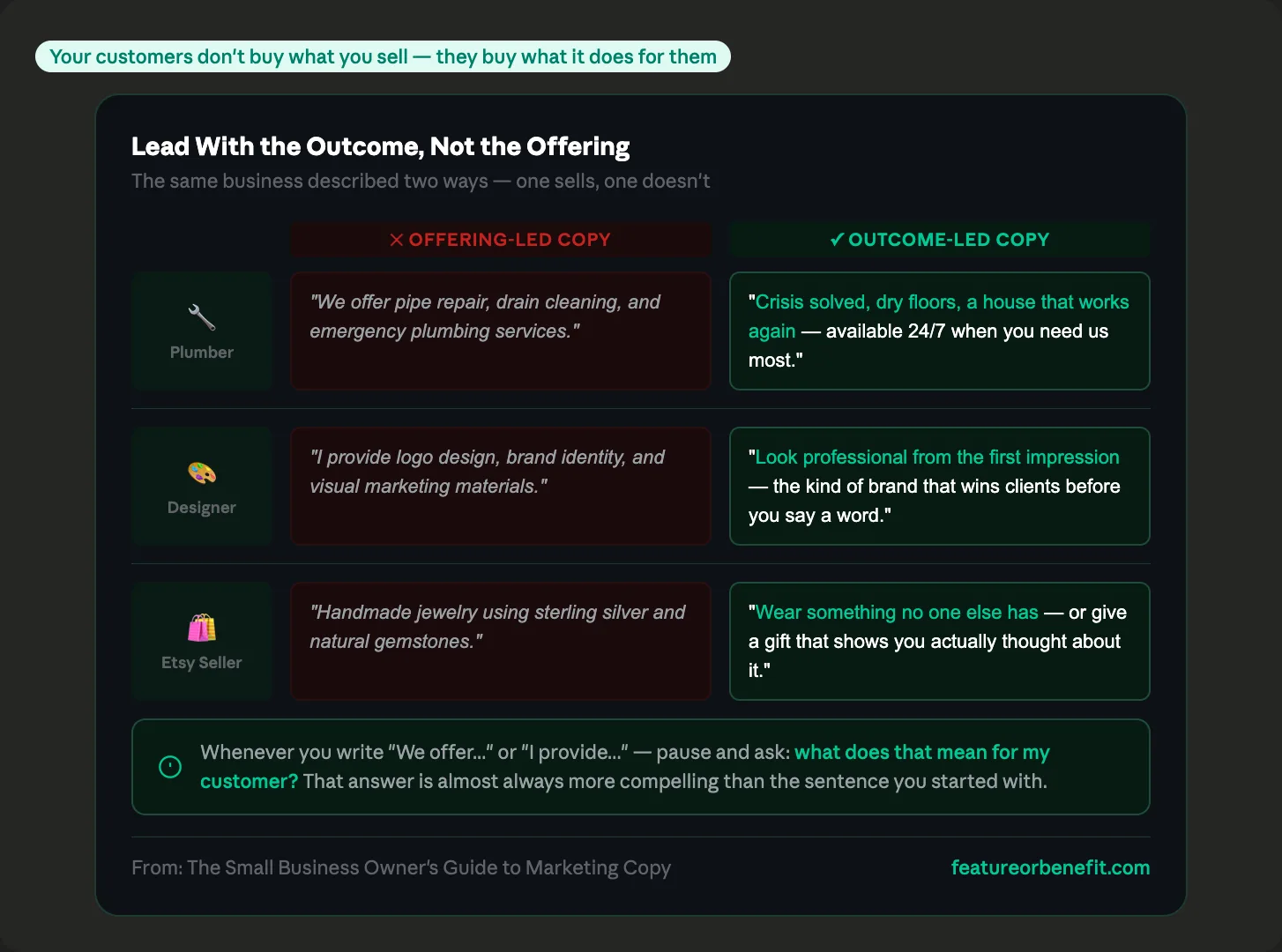
This distinction between what you offer and what the customer gets is the difference between feature-based copy and benefit-based copy, and it's the most impactful shift you can make to any piece of marketing you write.
A feature describes what your product or service is or has. A benefit describes what your customer experiences as a result. Features are facts. Benefits are reasons to buy.
Whenever you write a sentence about your business that starts with "We offer...", "Our product has...", or "I provide...", pause and ask: What does that mean for my customer? The answer to that question is almost always more compelling than the sentence you started with.
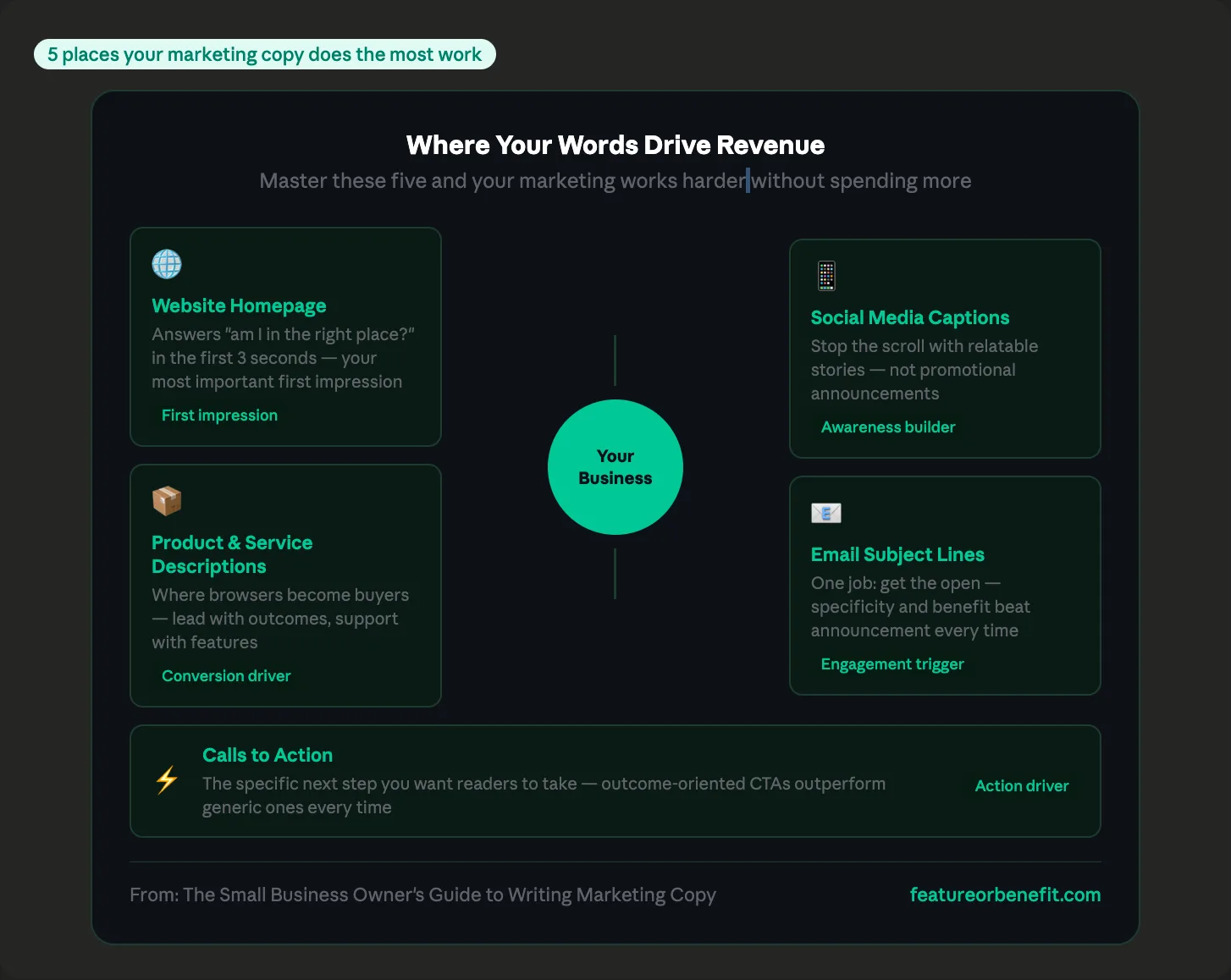
The Five Places Your Copy Does the Most Work
Marketing copy lives everywhere in a small business. But these five are where the quality of your writing has the most direct impact on revenue.
Your Website Homepage
Your homepage has one job: answer the question "am I in the right place?" for every visitor within the first few seconds. That means your headline needs to communicate what you do, who it's for, and why it's different. Use plain language, without jargon.
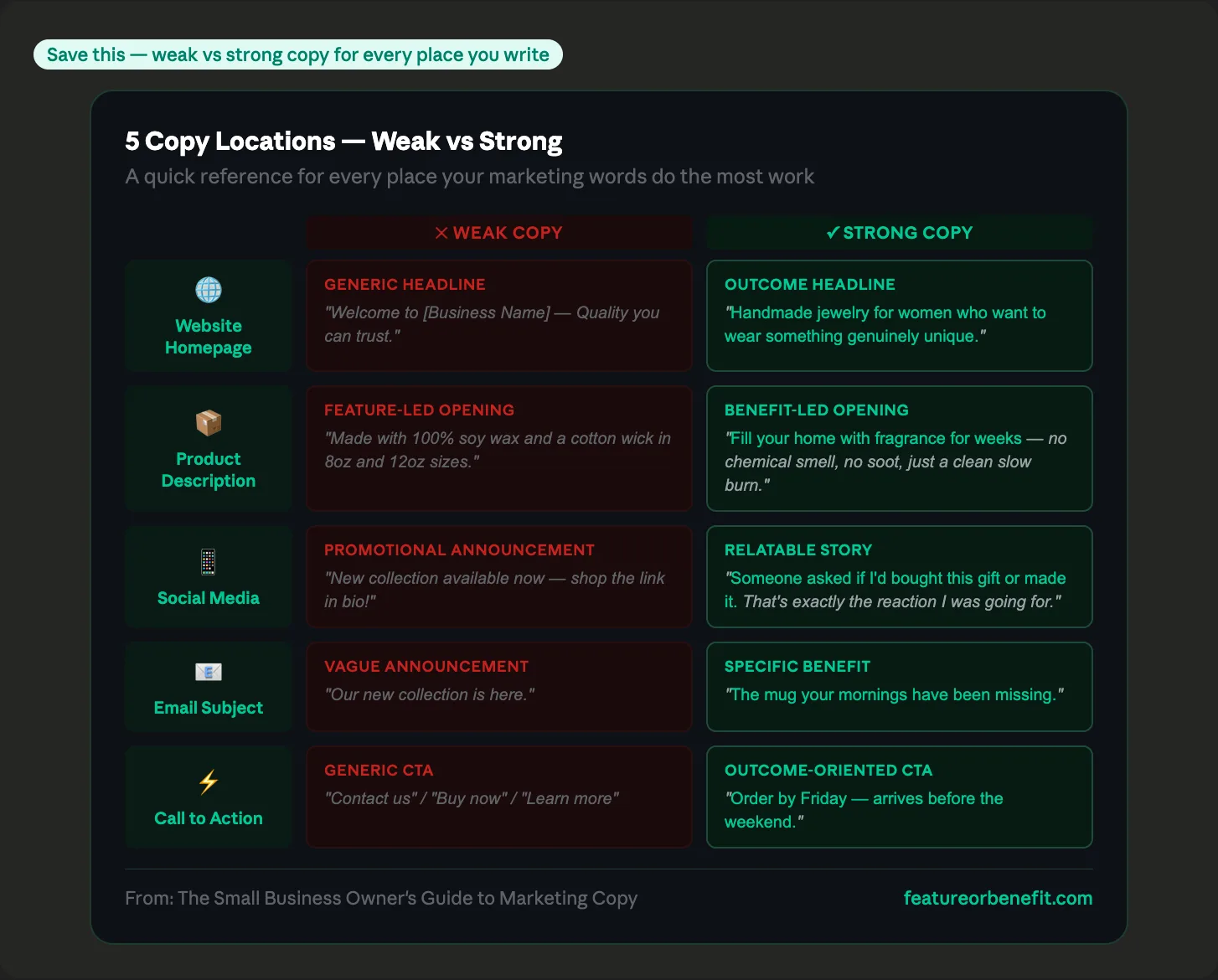
The most effective homepage headlines follow a simple formula: [Who you help] + [What you help them do] + [How you're different]. Not "Welcome to [Business Name]". That communicates nothing. Something like "Handmade jewelry for women who want to wear something genuinely unique" immediately tells the right visitor they've found what they were looking for.
Product and Service Descriptions
This is where most small business owners default to features like the materials, the process, the credentials. Buyers need benefits. Lead with the outcome your product or service delivers, support it with features as evidence, and close with a reason to act now. The full structure is covered in detail elsewhere on this site, but the short version is: outcome first, evidence second, action third.
Social Media Captions
The most effective social media copy for small businesses is relatable. Share the story behind the product, the problem it solves, or the moment it belongs in. Show the before and after. Let a real customer's words do the selling. The caption that performs best isn't "Shop now! Link in bio." It's the one that makes someone stop scrolling because they saw themselves in what you wrote.
Email Subject Lines
Your email subject line is a headline with one job: get the open. The principles that make headlines effective apply directly. Specificity beats vagueness, benefit beats feature, curiosity beats announcement. "Our new collection is here" is an announcement. "The mug your mornings have been missing" is a reason to open.
Calls to Action
Every piece of marketing copy ends with a call to action. This is the specific thing you want the reader to do next. Most small-business CTAs are generic ("Buy now," "Learn more," "Contact us") when they could be more specific and benefit-focused. "Get your free quote" outperforms "Contact us." "Start your free trial" outperforms "Sign up." "Order by Friday and it arrives before the weekend" outperforms "Shop now." The more specific and outcome-oriented your CTA, the more likely it is to get clicked.
The Three Writing Habits That Improve Every Piece of Copy
Write as You Talk
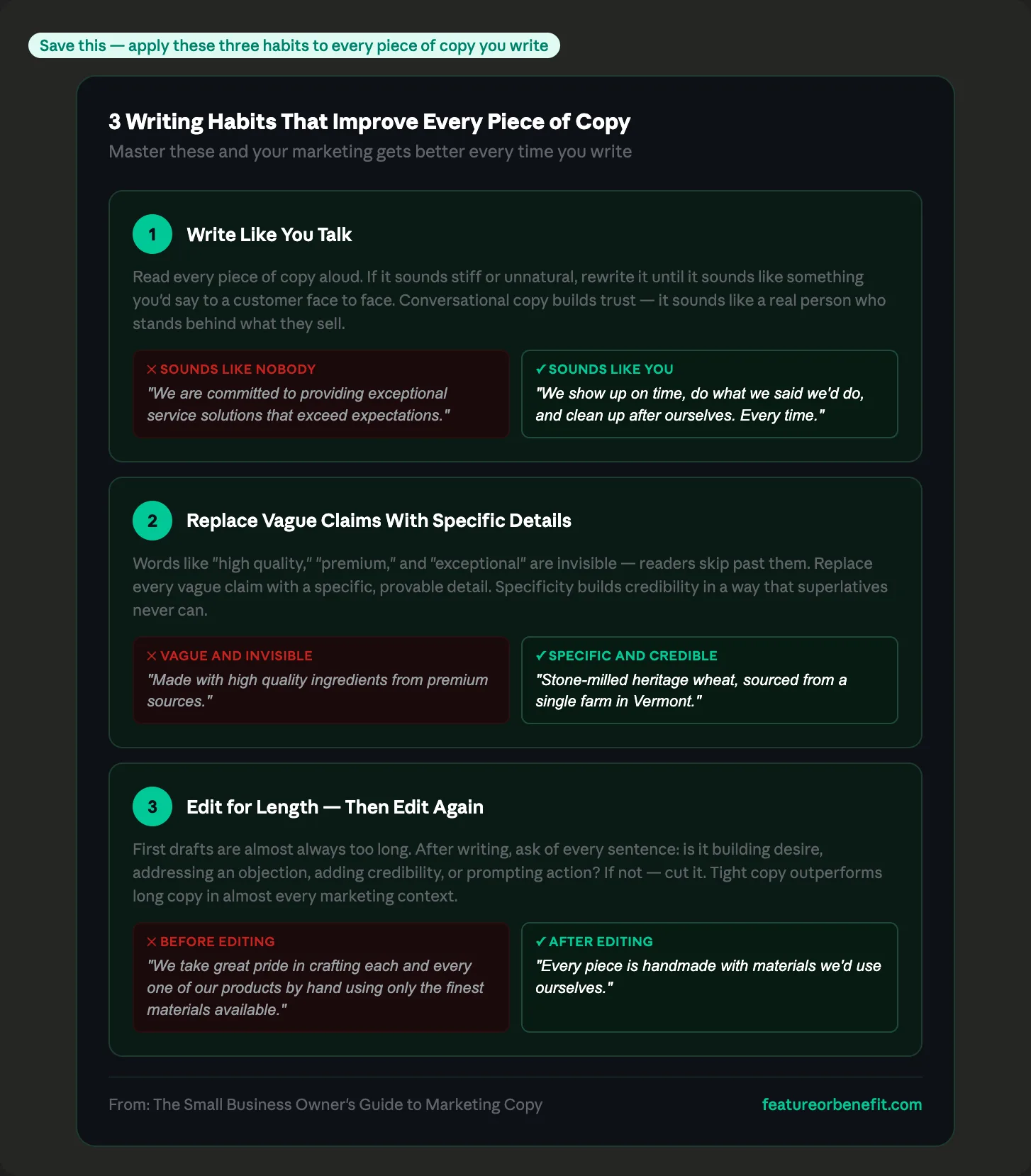
The most common reason small business marketing copy falls flat is that it sounds like nobody. It's formal, passive, and full of phrases no one would actually say out loud. Read every piece of copy you write aloud. If it sounds stiff or unnatural, rewrite it until it sounds like something you'd say to a customer face-to-face. Conversational copy consistently outperforms corporate-sounding copy for small businesses. It builds trust. It sounds like a real person who stands behind what they sell.
Replace Every Vague Claim With a Specific Detail
"High quality," "premium," "exceptional," and "the best" are phrases so overused they've become invisible. Readers don't believe them and don't respond to them. Replace every vague claim with a specific, provable detail. Not "high quality ingredients" but "stone-milled heritage wheat, sourced from a single farm in Vermont." Not "fast turnaround" but "completed and delivered within 48 hours, guaranteed." Specificity builds credibility in a way that superlatives never can.
Edit for Length, Then Edit Again
First drafts are almost always too long. Marketing copy that converts tends to be tighter and more direct than what most people write naturally. After your first draft, go through it and ask: Does every sentence earn its place? If a sentence isn't doing one of these jobs — building desire, addressing an objection, adding credibility, or prompting action — cut it. The discipline of editing is where good copy becomes great copy.
When to Use AI Tools, and When Not To
AI writing tools have become genuinely useful for small business owners who write their own copy. They're particularly good at generating multiple versions of a headline or subject line so you have options to choose from, translating feature lists into benefit language, overcoming blank-page paralysis by giving you a rough draft to react to, and suggesting different angles for the same product or service.
Where AI tools fall short is in understanding the specific voice, values, and customer relationships that make your business yours. AI-generated copy tends toward the generic without careful prompting and editing. The most effective approach is to use AI as a starting point and a collaborator. It is not a replacement for your own knowledge of your customers and what makes your business worth choosing.
The Skill That Unlocks Everything Else
Every principle in this guide — knowing your customer, leading with outcomes, writing specifically — comes back to one underlying skill: translating what your business offers into language that speaks directly to what your customer wants.
That translation is the core job of marketing copy. And the fastest way to practice it is to take a feature of your product or service and ask, "So what does that mean for my customer?" Do this over and over, for everything you sell, until the answers come naturally.
That's the skill that makes the difference between marketing that gets ignored and marketing that grows a business.
Need help finding the benefit language inside your product features? The Feature & Benefit Analyzer at featureorbenefit.com generates three compelling benefit statements from any product feature instantly — a practical shortcut for the translation work that makes your copy convert.