You've done everything right. Your product page looks great. You took great product photos. You set a competitive price. You wrote a description that covers everything the buyer needs to know. You've optimized your keywords. You're getting clicks but no sales — visitors who look but don't buy, and a conversion rate that makes you question whether the product is even worth selling.
The problem almost certainly isn't your product, your price, or your photos. It's your description — specifically, what it says versus what your customer needs to hear.
The Root Cause: You're Writing for Yourself, Not Your Customer
When most small business owners write a product description, they write from the inside out. They know their product deeply — the materials, the process, the specifications, the effort that went into creating it — and so that's what they describe.
The result is product copy full of features: what the product is made of, how it was constructed, what it measures, what certifications it holds. All accurate. All largely irrelevant to the customer's actual purchase decision.
Customers buy outcomes. They buy the version of their life where the problem is solved, the occasion is handled, and the feeling is achieved. They're scanning your description for evidence that your product will deliver that outcome. If it's there, they stay and buy. If it's not, they leave.
This gap between what sellers write and what buyers need is the single most common cause of product descriptions that generate traffic without generating sales.
Features vs. Benefits: The Distinction That Changes Everything
A feature is a fact about your product. A benefit is what that fact means for your customer.
Features describe your product. Benefits describe your customer's life after the purchase.
The distinction sounds simple, but it's surprisingly easy to miss in practice — especially when you're close to the product and proud of what went into making it. Here's what the gap looks like across a few common product types:
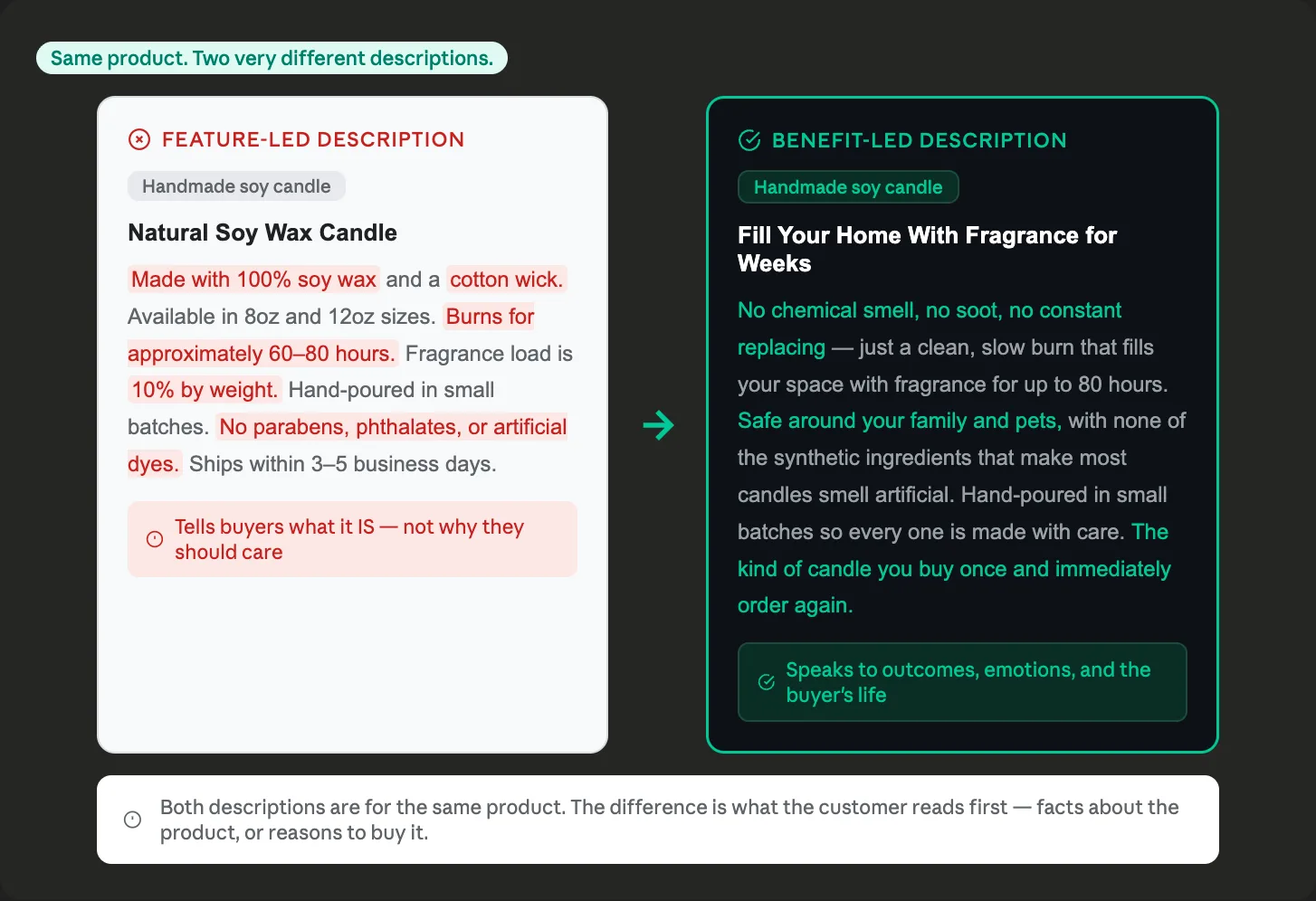
Handmade candle:
Feature: "100-hour burn time with a cotton wick and soy wax blend"
Benefit: "Fill your home with fragrance for weeks — no soot, no chemical smell, just a clean, long-lasting burn that doesn't require constant replacement."
Online course:
Feature: "Six modules with 24 video lessons and downloadable worksheets"
Benefit: "Go from overwhelmed beginner to confident practitioner in six weeks — structured lessons you can complete in under an hour a day."
Leather wallet:
Feature: "Full-grain vegetable-tanned leather, RFID blocking, holds 8 cards"
Benefit: "Carry less, access everything faster, and stop worrying about digital theft — a wallet that gets better looking every year instead of wearing out."
In each case, the feature is true and accurate. But the benefit is what actually motivates a purchase. The feature tells buyers what they're getting. The benefit tells them why they should care.
Why This Matters More on Some Platforms Than Others
The features-vs-benefits problem shows up everywhere, but its impact varies by platform.
On Etsy: Buyers browse emotionally, often shopping for gifts, home décor, or items that reflect their personality or mark an occasion. Emotional benefit language performs significantly better than clinical feature language in this context. A description that makes a buyer feel something is far more likely to convert than one that informs them.
On Shopify and your own website: You control the full experience and have more room to make the case for your product. But without the built-in marketplace traffic of Etsy, every word of your description needs to work harder to justify why a visitor who found you through search or social should trust you enough to buy.
On Amazon: Customers can compare multiple listings simultaneously. Benefit-focused bullet points at the top of your listing — the part most buyers read before deciding whether to scroll further — are often the deciding factor in a crowded category.
In every context, the underlying principle is the same: customers want to know what your product will do for them, not what it contains.
The Five Questions That Unlock Any Benefit
If you're staring at a feature and struggling to find the benefit inside it, these five questions will get you there:
1. So what? After every feature statement, ask: "So what does this mean for the customer?" The answer is almost always the benefit. "Double-wall insulation" — so what? It means "your drink stays at the right temperature all day without you thinking about it."
2. What problem does this solve? Every feature exists to fix something. Name the problem directly rather than describing the solution in technical terms. Customers recognize their own problems immediately and respond to copy that speaks to them.
3. What can they do now that they couldn't before? Features enable capabilities. Focus on what becomes possible for the customer — the activities, freedoms, and experiences your product unlocks that they didn't have access to before.
4. How will they feel? Emotional outcomes are often more persuasive than practical ones. Confidence, relief, pride, peace of mind, excitement — these are the feelings that actually motivate purchases, especially for discretionary products.
5. What won't they have to worry about anymore? Removing anxiety and friction is as powerful as delivering a positive outcome. If your product eliminates a recurring frustration or a nagging concern, say so directly. "Never worry about..." is a phrase that converts.
Work through these five questions for every feature in your product description and you'll consistently find more compelling, customer-centered language than you started with.
Common Description Mistakes That Kill Conversions
Beyond the features-vs-benefits gap, these writing patterns consistently hurt conversion rates:
Leading with your story instead of the customer's outcome. Your brand story is valuable, but it belongs later in the description. Open with their outcome, not your origin.
Using vague superlatives. "High quality," "premium," "beautiful," and "amazing" appear in millions of product descriptions and mean nothing. Replace every vague superlative with a specific detail: not "high quality stitching" but "triple-stitched seams that won't split after a season of heavy use."
Writing one description for every customer. Different buyers have different reasons for purchasing the same product. A candle buyer shopping for themselves has different motivations than one buying a gift. If your product serves multiple buyer types, address both — the gift angle in particular converts well on marketplaces like Etsy.
Burying the most important information. Most marketplace browsing happens on mobile, where buyers often read only the first two or three sentences before deciding whether to scroll. Lead with your strongest benefit statement, not with materials or dimensions.
Forgetting the call to action. Many product descriptions end abruptly without giving the buyer a clear next step. A simple closing line — "Order today and it ships within 48 hours" or "Add to cart and it arrives before the weekend" — reduces hesitation and moves the buyer toward a decision.
How to Audit and Rewrite Your Existing Descriptions
If you have an existing product catalog, a description audit is one of the highest-ROI activities you can do for your conversion rate:
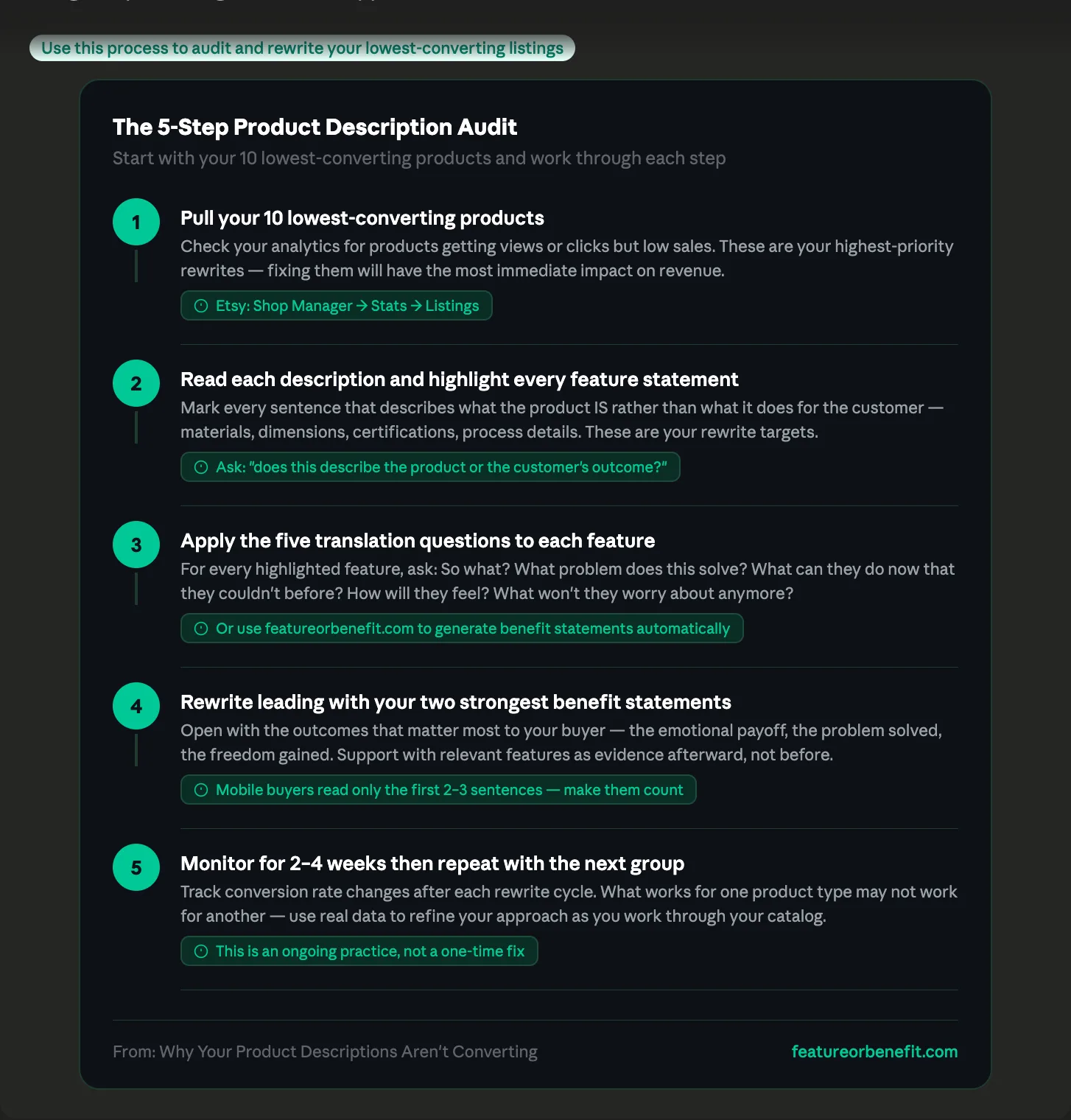
Step 1: Pull your ten lowest-converting products — the ones getting views or clicks but not sales. Most platforms provide analytics that show you which they are.
Step 2: Read each description and highlight every sentence that's a feature statement — every fact about the product that doesn't describe the outcome the buyer wants.
Step 3: For each highlighted feature, apply the five questions above to find the benefit hidden inside it.
Step 4: Rewrite the description, leading with your two or three strongest benefit statements, then supporting them with relevant features as evidence.
Step 5: Monitor your conversion rate for two to four weeks, then repeat the process with the next group of low performers.
This is an ongoing practice, not a one-time fix. The best-converting product descriptions are refined over time as you learn which language resonates with your specific buyers.
A Faster Way to Generate Benefit Statements
Working through the five questions for every feature in a large product catalog is time-consuming. If you have dozens or hundreds of products to rewrite, the manual process can feel overwhelming enough to put off indefinitely — which means your conversion problem waits to be fixed.
The Feature & Benefit Analyzer automates the translation. Enter your product features and the tool instantly generates three compelling benefit statements. Export them as a PDF or text file and they're ready to drop into your product listings, website copy, or marketing materials.
Try it free at featureorbenefit.com — no credit card required.